Neon Hearts

No sooner had Steve Heart exited the Suburban Studs with his sax under his arm than he formed the excellent Neon Hearts in the summer of 1977.
In true punk fashion, they released the classic double A-sided single, Regulations and Venus Eccentric, on December 1, 1977, on their own Neon Hearts Records. But then a big mistake in signing to Satril a subsidiary of WEA (who had signed the Suburban Studs) ended with the band being screwed over.
Keith the drummer, would go on to play in mod band The Circles and Steve Heart would open a rehearsal studio. Paul Raven would go on to find fame in Killing Joke’s Love Like Blood period, replacing Youth, and various industrial bands before passing away in 2007 aged just 47.
In the summer of 1977, Steve Heart quit Birmingham-based Suburban Studs following musical differences (the band feeling a saxophone player inappropriate in a punk band) and returned to Wolverhampton to form a new band. He’d already written several songs and soon began recruiting members.
Along with Steve, his cousin Paul Raven was on, Keith Allen on drums, and Martin Ratcliffe on guitar. At the time, Keith was working in a town centre shop called Langdon’s Electric Music. His boss, Pete Langdon, allowed the band to rehearse in the empty flat above the shop. From then on an intensive rehearsal schedule was put into force with the band rehearsing for 3 hours every night, followed by a pint at the pub.

The band, still unnamed, recorded a selection of their material at Pogo Records. Ron and his producer, Del Spence, liked the band but thought a stronger vocalist was needed, thus putting the dampers on Martin and Steve’s shared vocal efforts! So, armed with a tape of their material, the band began looking for a singer. An encounter with solo singer Tony Deary, later to call himself Tone Dial, added the final piece to the jigsaw.
Intensive rehearsals continued. Soon the band was musically very tight and a prolific song writing unit had developed. Many days and nights were spent at Tony’s flat writing new songs. Lots of spare time was used writing and arranging in a spare room at Martin’s place, ready for rehearsals. They decided to call themselves Neon Hearts.
In autumn 1977 the band were satisfied with their songs, so they booked a demo session at Ginger Studios in Aldridge, near Walsall. The studio was owned and run by Phil Dawson and was literally a garage built on the side of his house.

Phil was also an engineer-producer at Birmingham’s Radio BRMB. BRMB was the station to be on, with presenter Robin Valk taking a huge interest in local music. Neon Hearts fast became one of Valk’s favourites, and so their music was heavily featured and they did several interviews for the show.
After the first sessions at Ginger Studios, two songs were recognisable as exceptional: Regulations and Venus Eccentric. These were to become the double A-sided single released on 1st December 1977 on the band’s own label, Neon Hearts Records, based at bass player Paul’s home in Tettenhall, because of its convenient location.
Studio sessions were paid for with dole money clubbed together by the band. The single was financed by a loan from two Wolverhampton businessmen, one of whom was Pete Langdon. Later, most of the band were to live in the flat above his shop, using it as the main base for all band activity. The first pressing of the single in its oversized (8” sleeve) sold so well that the band was able to pay back the loan almost immediately. During this initial period the band found themselves under investigation from the Social Security offices, who were disappointed to discover they were legitimate and not making a fortune at their expense.

With the single riding high in the indie charts, Neon Hearts began gigging frequently, playing nationally, including several London dates. Encouraged by the response from the audience, they decided to stay in London for a few days and push themselves to several record companies, unfortunately without luck.
The band were not deterred by this minor setback. With a large following and not many places to play in Wolverhampton, Neon Hearts approached one local pub owner to see if they could hire a room as a venue on a regular basis. The owner was a local musician called Chico Arnez ran the pub, The Lord Raglan. The room was hired on a “let’s see how it goes” basis.

On the first night, in April 1978, there were about 150 people queuing outside, all dressed in punk gear, but all well behaved. However, the landlord panicked and tried to cancel the gig. The band ensured they would prevent and reimburse any damage and so the gig went ahead. The night was a great success and saw the beginning of a regular weekly gig. Bands were booked from all over the area and the acts were paid well, although only expenses were guaranteed.
Central to the Birmingham scene was a salubrious club named Barbarellas. The band played many memorable gigs there, including spots with Generation X, Ultravox, Radiators From Space, The Clash and The Cure.
The band were now beginning to attract a lot of record company interest. One company was contacted via a music journalist who’d seen them live in London and was hawking the single to labels. John Mostyn of Birmingham’s Oak Agency went to see them play The Lord Raglan (which they did about once a month) and was highly impressed. He began booking the band and got them onto the highly desirable “University circuit”. Soon the band were gigging as far afield as Canterbury University, Leeds F Club, and Exeter Roots. John Mostyn later managed The Beat and Fine Young Cannibals, proving his eye for talent.
Throughout this period record company interest increased, but was narrowed down to two main candidates. Unfortunately for Neon Hearts’ future, both band and their advisers picked Satril, a satellite company of WEA, and signed with them in May 1978.
From day one, problems occurred with Paul Jenkins (A&R). He had no idea where the band was coming from and Henry Haddaway (the owner) just didn’t have a clue, period! Attempts to get the band to move into a more “funky” direction and submit material to the Eurovision Song Contest were met with short shrift. Being optimistic, Neon Hearts felt things would improve. However, things worsened and they ended up trying to make the best of a bad job.


The first demos for Satril were recorded at PYE Studios in London on June 6th 1978 under the supervision of Haddaway and Jenkins. The band wanted to release Popular Music as their Satril debut, but they were overruled by the label who chose Answers, which was released late July 1978.
The single was given no promotion by Satril so the band self-promoted it by gigging. The band were self-managed and the stress and frustration was beginning to tell. After a period of label inactivity, Satril requested an album. Satril dismissed much of the band’s current material, preference being given to early material from which the band had progressed. The album became a mish-mash of early Satril demos and a few tracks recorded at Magrite Studios in Harmansworth (near Heathrow).
Satril agreed to release ‘Popular Music’ as the second single, but by then it had lost its relevance to the musicians and, to make matters worse, some lyrics were altered to reduce the likelihood of offence to Radio One, which would jeopardise chances of airplay. The original lines read, “Who needs the top twenty / Who needs deejays / who needs number ones?”
These were watered down to the far less punchy, “Tune in to the top twenty / Tune in to deejays / Tune in to Number Ones.” The single was premiered on local TV program, Look Hear, in late 1978 and released in February 1979.
The band were given no involvement in the production or the final mixes for the album, which were done without their consent. The first time they heard the recordings was when they were handed finished copies of the album.
At no time did the Neon Hearts, collectively or individually, ever receive any royalties from Satril Records for any songs released by Satril. To this day the band has still not received a financial statement, any payment for the album or singles, nor any royalties or publishing.
Before the release of the album, Keith, the drummer, decided to leave due to ill health caused by continued gigging and frustration with Satril. Every meeting with Satril ended in a blazing row, so communication was kept to a minimum.
The band continued getting considerable media interest, but as they were about to begin auditioning drummers, Martin, the guitarist, also decided to leave due to frustration with Satril as well as personal and musical differences.

The band began to change dramatically when new drummer Mark Fuller joined Steve, Paul and Tony. Tony played guitar and sang while Steve started experimenting with electronics on his saxophone.
Neon Hearts became less poppy and more powerful sounding. Regular live performances and constant rehearsing at their studio in Wolverhampton saw a rapid improvement in their new material. They demoed new material, one song ‘You Keep Coming Round’ (1979, Play Back Studios, Wolverhampton) particularly stood out.
The band was offered a John Peel Session. It was recorded virtually live on March 21st 1979 at the Maida Vale Studios in London with just a few vocal overdubs. The tracks were ‘Roll-On Deodorant’, ‘Rings Of Confidence’, a re-working of ‘Body Language’ and a great song called ‘The Other Great Sex Pros (Airborne Hormones)’.

This song was so new that no lyrics were written. The band could think of nothing as they tried writing in the studio until Tone Dial had a brilliant idea. In his pocket he had a letter he’d written to a friend, Peter Finch, so they ran the track and Tony read the letter.
The producer and the engineer thought it worked so well they went with the first take! The session was transmitted twice on John Peel’s show and was one of his favourites from the year. And without Satril involved, the Neon Hearts got paid.
The Peel session was used to advertise for a guitarist to allow Tony more on-stage freedom, but no suitable candidate was found. The band continued gigging until the release of the album by Satril in April 1979. However, frustration with Satril was so intense that Tony decided he’d had enough, but stayed to honour all existing live commitments.

Shortly after Paul left too. He formed a band called Burned Out Stars before joining Killing Joke. Tony formed a band with local musicians called Silhouette Theatre. Steve Heart persevered with a new line-up of Neon Hearts, but things were never the same and the band was eventually terminated.
Steve formed another band, demoed a lot of material and had some record label interest but nothing materialised. Tony joined Fashion, who had a large local following and had supported Neon Hearts at a gig the previous year at Wolverhampton’s Wulfrun Hall.
Tony’s involvement with Fashion was short-lived, but he kept in regular touch with Steve. In late 1980 Steve and Tony arranged a meeting at a Wolverhampton pub called The Spring Hill, exchanged ideas and voiced the frustrations of the past few months. The meeting was so successful that Steve and Tony decided to reform Neon Hearts.
Martin was asked to join, this time playing bass, Tony played guitar and keyboards, Steve was on sax, and an enthusiastic new drummer, Mark Spruce, was found.
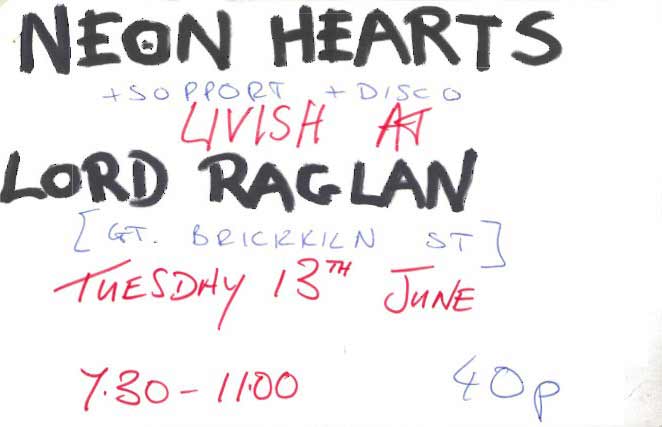
A new set was written and the band started a new venue not far from the Lord Raglan. At the Royal Oak the four hired a room and called the club Fiction Factory. On March 20th 1981 a packed venue greeted the debut performance of the new line-up of Neon Hearts, but sadly most wanted to hear the old material. The band did not indulge them, but were still well received. One more gig was played with this line-up, at the Giffard Arms in Wolverhampton.
Between December 1980 and March 1981 the final Neon Hearts recordings were made, on a 4-track portastudio at various houses in the town. Eight tracks were recorded, three of them appear on this CD; ‘Fighting Depression’, ‘Other Fine Stores’ (a tribute to John Lennon whose death was announced on the radio as they arrived at Martin’s flat to record) and ‘Alien Girls’.
Once again there was record company interest, but no signings.
TalkPunk
Post comments, images & videos - Posts are checked and offensive or irrelevant ones will be removed