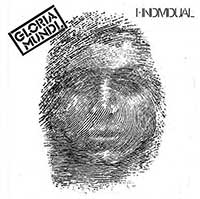
Richard Cabut Interview – John Wisniewski March 2026
Richard Cabut is an author, journalist, former punk musician with band Brigandage and a long-time chronicler of the underground. He has written about punk and post punk in music papers such as the NME (in the 80s – pen name Richard North), where he coined the phrase ‘positive punk’ to describe a ‘movement’ which preceded goth; in his own fanzine, Kick (1979-82); in many other magazines e.g. Zig Zag, Siren, Offbeat; and in various books, including Punk is Dead: Modernity Killed Every Night (Zer0 Books, 2017), and the post-punk novel Looking for a Kiss (PC-Press, 2022), which has been adapted for screen. He played bass for the punk band Brigandage (LP Pretty Funny Thing – Gung Ho Records, 1986) between 1983 and 1987.
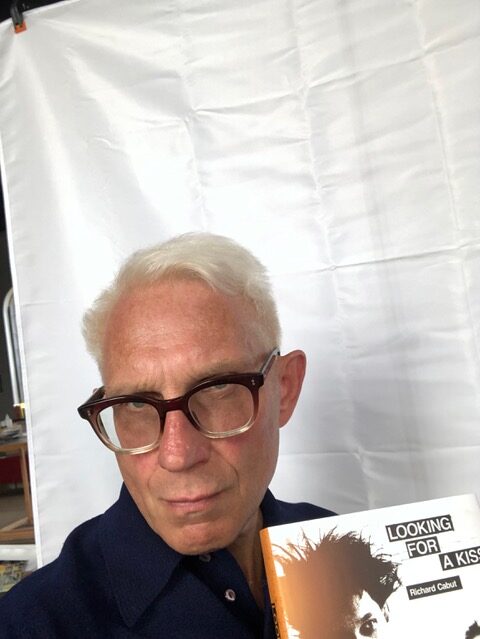
1. What were your early days like, Richard? Where did you grow up?
I was brought up in a Polish household in Dunstable, Bedfordshire. My family had been ethnically cleansed from their homes in what was then Eastern Poland to Siberian labour camps, and from there to the UK via Uzbekistan, Palestine, Persia, Uganda. I didn’t speak English when I started school. Because I was from Catholic family, I had to sit in a room on my own while everyone else attended the daily C of E assembly. Needless to say, I felt like an outsider from the very start. But as the years went on, I also felt an outsider from Polish Catholic family life, which was repressive and stultifying.
I was born in Aylesbury, Bucks, and, as said, grew up in Dunstable. Thirty miles up the M1 from London. Suburbia largely. There, kids left school and went on the track, the production line, at the local factory, Vauxhall Motors. If you got some qualifications you could join the civil service. Meanwhile, some couples had been going out with each other since 3rd Form and watched telly round each other’s house every night, not saying a word to each other – a preparation for marriage. I didn’t know what I wanted, but I knew I didn’t want any of that.
Instead, I was in love with punk rock. In love with picking up momentum and hurling myself forward somewhere. Anywhere. Rip up the pieces and see where they land.


In my Dunstable bedroom there was Mark Perry’s fanzine Sniffin’ Glue (and Other Self Defence Habits) (July ’77), some Aleister Crowley, a bit of Sartre, the fanzine 48 Thrills (bought off writer Adrian Thrills at a Clash gig), Sandy Robertson’s mag White Stuff (from Compendium in Camden) and John Peel on the radio, of course. And tons of records – I loved the smell of fresh new punk vinyl, as well as the slightly different scent of Jamaican imports (pressed on old recycled vinyl, because of cheapness rather than eco awareness) – all of it a shining, odorous promise of unexpected imaginings. It smelled of the future. The intensity of sitting in a loud room in a silent town, full of electricity. Floating above circumstances. Soaring… and flicking V-signs during the Jubilee itself, while nicking union flags from wherever they can be found (everywhere), and invariably hanging out in the ladies (à la the Roxy Club) – although this had repercussions! And everyone was still into funk, too: the California Ballroom was Dunstable’s equivalent of the more famous clubs the Lacy Lady or Global Village. Since ‘75 or so, hip kids had been travelling from miles around (especially from London) for the plastic sandals and pegs scene there. It was all quite retro, too – 40s swing fashions – until punk.
The 70s were generally a period of transformation and discovery – there was time and space to find out about yourself, change yourself, and find out just what it was that you wanted to do. The period was a springboard into the future – propelled by an unlimited, uncoordinated, frantic, out-of-control energy.
2. What did you think of the Punk movement in 1976 with The Sex Pistols and Clash?
I first came across the Pistols in April 76 after reading a piece in the NME about their Nashville gig, which described a band who beat up their own audience. In Rotten’s eyes I saw the power and possibility of creative violence, as it were.
I bought the Eddie and Hot Rods Live at the Marquee EP in the summer of 76, and wondered how to dance to it; the Damned’s New Rose and the Pistols’ Anarchy in the winter of that year. Before that was the Horses LP by Patti Smith, whose poetry books I picked up from Compendium Books in London in the summer of 76. I also saw Dr Feelgood in 1976, which opened some doors.
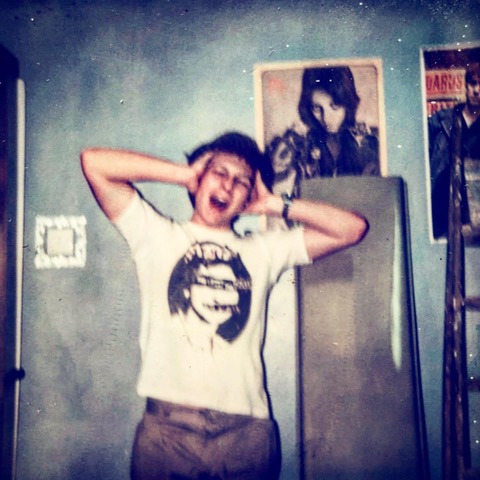
I was a suburban punk Everykid in pins and zips, with a splattering of Jackson Pollock and a little Seditionaries – I remember standing outside the shop and wondering whether I had the right credentials to go in. I asked myself: am I revolutionary enough? Am I punk rock enough? I decided I was. Jordan served me – I bought some tee shirts. Decades later, after I had got to know Jordan as a friend, I told her my story, adding that I now felt silly to have worried. I expected her to agree, but she said I was right to be concerned, that she/they only wanted people with the right attitude in the shop.
As for the Pistols and Clash – seeing the last night of the White Riot tour, May 1977, at the California Ballroom was life-changing. And I was at the Sex Pistols gig in 1977 in Leighton Buzzard, at the Bossard Hall, only for it to be banned and cancelled a couple of hours before it was due to begin, which was consciousness-altering in a different way. But it’s good to have a balance between positivity and nihilism, right?
3. Could you tell us about coining the term “Positive Punk” in 1983? Did you expect to influence the beginning Goth movement?
I wrote the Positive Punk article for the NME in December/January/February 82/83. At that time there were three distinct groupings in the punk scene. The Oi-sters and Herberts, who were basic and Gumby-ish RE music, fashion and behaviour. The anarchos, who were like a mass of black, in terms of clothes and demeanour. And then you had a loose, nameless collection of punks and former punks who were colourful, and full of, it seemed, vim, dash and go-ahead spirit. These folk tended to go to see roughly the same bands and attended the same sort of clubs. I wrote about many of those bands and places, ranging from the Batcave and the Specimen, to the Mob (who were sort of anarcho-plus).
It was obvious that something was going on, and the NME asked me to write a piece about it. Originally, I didn’t use the name ‘positive punk’, or any umbrella term. But the paper needed an easy hook to snag readers. Positivity, I suggested when asked, was a common denominator, so hey presto… a little alliteration goes a long way.
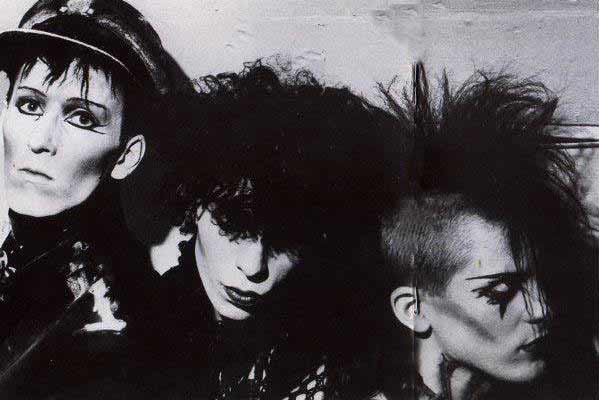
Of course, Positive Punk was a disaster. As soon as something is named, people have a target to attack. Also, factions within the scene quickly appeared. The style magazine The Face, for instance, also did a follow up Positive Punk piece, but the Sex Gang Children refused to become involved – because they couldn’t control it. Their noses had been put out of joint. The big wigs in the scene, your Sex Gangs and Southern Death Cults, had suddenly been usurped, or so they thought, by upstarts like Blood and Roses.

Overnight, the atmosphere changed from togetherness to suspicion, jealousy and loathing. This would probably have happened in any case, but the Positive Punk article greatly accelerated the process. As far as I am concerned, Positive Punk described the ‘Passage of a few People (wearing makeup and top hats) through a Rather Brief Moment in Time.’ I think it was accurate. In hindsight, the music wasn’t great, which was probably the real downfall. And then it turned into goth, with even worse music.
The academic Mathew Worley wrote in No Future: Punk, Politics and British Youth Culture, 1976–1984 (Cambridge University Press): ‘Richard Cabut (Richard North) was the first to outline the basis of what eventually became codified as “goth”. Pointing to erotic politics of the Doors, ‘tense dusky danger ‘ of the VU, the Ants sensuous black style.’
4. Could you tell us about writing “Punk is Dead”. Did you see punk as a way to cause change, for the betterment of society?
The book is called, to give it its full title, Punk is Dead: Modernity Killed Every Night – I hate the Punk is Dead title – it’s meaningless; but the editor at the publisher Zer0 Books insisted – you have to have ‘punk’ in the title to sell it.
The book is an anthology, with contributions from some of punk’s most important commentators and participants including Jon Savage, Judy Nylon, Penny Rimbaud, Jonh Ingham, etc. It was commissioned and put together mostly by myself – I also provided an introduction and wrote seven further chapters.
The book, which I’m proud of, looks at some depth with an incisive cutting edge at, well, punk rock. It captures, I think, the subversive energy of the time.
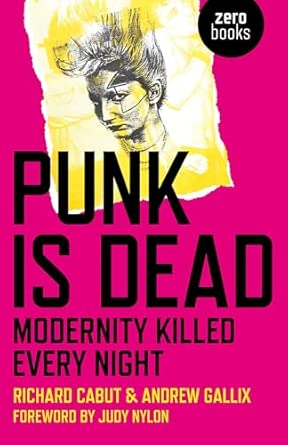
The book was widely reviewed. ‘Punk is Dead shows the transmission of culture as a kind of lucid group dreaming,’ Kris Kraus, The Times Literary Supplement, 9 January, 2018.
The epithet to my introduction of Punk is Dead: Modernity Killed Every Night came from Donald Barthelme’s novel Snow White : ‘Our becoming is done. We are what we are. Now it is a question of rocking along with things as they are until we are dead’ Making the point in the beginning punk was constantly in the process of forming. I don’t know about the betterment of society, but I think if we don’t keep it up, the uncertainty of revolt that punk represents, then there is little left but to submit to the overwhelming power of a closed system operated according to the logic of nothing but business.
5. Tell us about starting your punk magazine KICK. What did you hope to accomplish?
If, as the cliché has it, escape from the US ghetto could only be achieved by means of sport or showbiz, then either learning three chords or scrawling a fanzine was the easiest way out of the suburbs for bored punk rockers.
I couldn’t play the guitar at the time, but I loved literature. Alongside as the usual teen beatnik, Camus and Beckett reading list, I’d read one of those ‘day in the life’ type pieces by SG’s Mark P, in a 1976 issue of Melody Maker. He had just given up his bank job – it was holding him back from hanging out with the Damned in Rough Trade, going to gigs and spending most of the next day in bed – with girls! I realised there was something in this fanzine business.
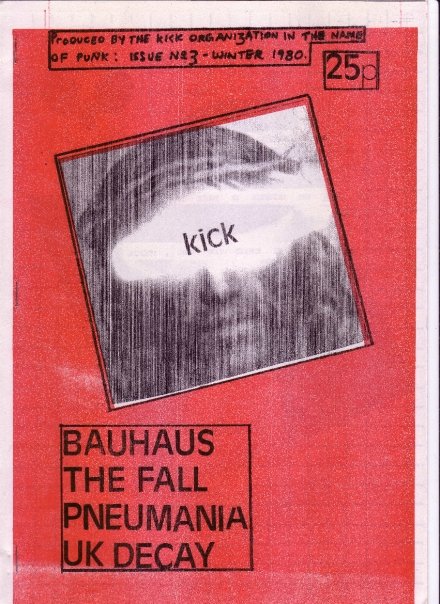
My fanzine, called Kick, took a while to gel. As with every art form, it takes a while to find your feet, and more importantly, your own voice. But I’d like to think that by the last couple of issues I was showing green shoots of achieving my intent, which was to portray life/punk/culture as something rooted in romance, defiance, and rebelliousness. It was advocation evocation and invocation of the modern version of the Bohemian lifestyle as a superior, more stimulating choice – philosophically, intellectually, spiritually, fuckologically – to one based on traditional values.
I wanted to reach out beyond level planeness, two-dimensionality into a world where it’s possible to discover meanings.
I did it mostly by myself, but from Number 3 onwards, a young French punk called Lill became involved to an extent. She just knocked on the door one day and introduced herself – she’d read a copy of Kick and was enthused. People did that kind of thing back in the 70s and 80s. Those who wanted to communicate wrote letters – and then turned up. Wonderful. It was all a part of the adventure – and the point of punk in those years was that it was nothing if not an adventure. Listening to records or going to gigs was the least of it, at least as far as I and the people I largely associated with and I were concerned. The idea was to live a creative, adventurous lifestyle.
Going around to Lill’s place was definitely an adventure – she lived in a punk squat in Coronation Buildings in Vauxhall – just down the road from Campbell Buildings, which was mythologised by Blood and Roses’ Bob Short in his book Filth. Both places were similar in look and vibe – dank Victorian blocks full of the desperate and the damned, not the Damned tho’. You didn’t know what or who you’d find when knocking at the door – more than once, I turned up to find that the place had been raided and ransacked by a roving gang of skinheads, who’d beaten up the guys and abused the girls. This sort of skinhead terror was a hazard in certain parts of London punk squatland in the late 70s and early 80s.
Lill lived by begging every day – and I hated being dragged off across Vauxhall Bridge to ponce loose change from commuters. It was embarrassing, frankly. And I certainly didn’t think the point of punk was to engender a look of pity in the eyes of the passer-by.
I started writing for the NME towards the end of 1982. Age 22. This was probably one of the reasons why the fifth edition of my fanzine, Kick, was never printed, although I had already put together much of that issue. Echoing the 1960s/70s exodus of writers from the underground press to the mainstream, I jumped on the music press bandwagon, as did many of the main punk fanzine writers. Why? The consensus amongst ourselves was that we had ‘sold out’ in order to further push ‘our’ bands and ‘the revolution’.
6. Could you tell us about starting your own punk band Brigandage? What was that experience like?
I didn’t start Brigandage. I was involved with the singer, who was thrown out of her own band for various reasons, so I became the bassist of the new line up. My time in that band (83-87-ish) was characterised simply, to paraphrase Malcolm McLaren, by trying to create an environment in which I/you, if you wanted, could truthfully run wild. Having life adventures whilst posing, I suppose. ‘I was living in my own colourful movie (an early-ish Warhol flick some of us liked to think), which I was sure was incomparably richer, more spontaneous and far more magical than the depressing, collective black-and-white motionless picture that the conformists had to settle for,’ – to quote myself from my novel Looking for a Kiss. Also I had a really cool cream coloured 1977 Fender precision bass – exactly like Sid’s.
They were exciting and productive times – I made some nice handouts and posters, played some wicked gigs (our last can be seen on YouTube in its entirety) helped to record a ‘best-selling’ cassette-only release, FYM, complete with magazine, as well as an LP, Pretty Funny Thing.
By the time of the LP, the Pistols-style punk that had characterised the tone and lustre of the band’s former incarnation (circa my Positive Punk piece for the NME, the band’s brilliant John Peel session and, to a diminished degree, our 1984 live/demo cassette-only release FYM (F.O. Reckords)) was gone.
We – the singer Michelle and I – had new loves and obsessions that fuelled our rot ‘n’ roll dreams. Namely, the Velvet Underground archetype that spoke of viciousness, lust ‘n’ hate and leather (a fantasy of style); life as film noir, existential, nihilistic and a little apocalyptic, I guess; silver art – white heat, pale, glamour frail with the sheen of squalor; downtown slow dive low life, and other throwaway thrills. You get the idea. It was bound to end in tears.
This was the Uptight Brigandage – clean, hard and laced with layers of acerbity and disdain – although not to be mistaken for some sub-Thunders wasted glam crew of the time.
The LP was recorded in some toilet (literally – great acoustics) called Globe Studio, and mixed at Terminal 24 near the Elephant, in London. I mostly remember the anxiety and paranoia, suspicion and delirium, the insomniac insouciance, the psychic fallout with our sophisticated cool well and truly blown. Yes, it was all fun and frolics!
Unsurprisingly, this version of the band split shortly after the LP was released. The magic was elsewhere.
7. Any favourite music artists? Do you listen to non punk music artists?
While working I usually listen to Mixcloud – mostly dub, low event horizon music, spiritual jazz. 1970s Polish jazz is current love. Music always keeps life ticking along – the heartbeat, the soul and all.
8. Did you see punk as group lucid dreaming?
The lucid dreaming thing is from the Kris Kraus review of Punk is Dead: Modernity Killed Every Night – and it’s quite valid. Punk, if you choose to look at it in this way, was lucid dreaming in motion. It was dreaming inside a world of commerce, conformity, and authority, while refusing to sleepwalk. Like a dreamer aware of their dream, punk confronted fear, frustration, and desire head-on, reshaping reality with raw immediacy.
The DIY ethos, the torn clothes, the screaming riffs – all tools of self-determination – turned rebellion into creation. Punk didn’t just reject; it imagined, it remade, it provoked. It insisted on its own narrative, dreaming awake. Society’s norms were no longer fixed; they were clay, and punk was the hand moulding them. In this lucid state, punk revealed that the world could be other than it seemed – and dared one and all to join in the dreaming. My tip: never wake up!
9. What influenced you to write Looking for a Kiss?
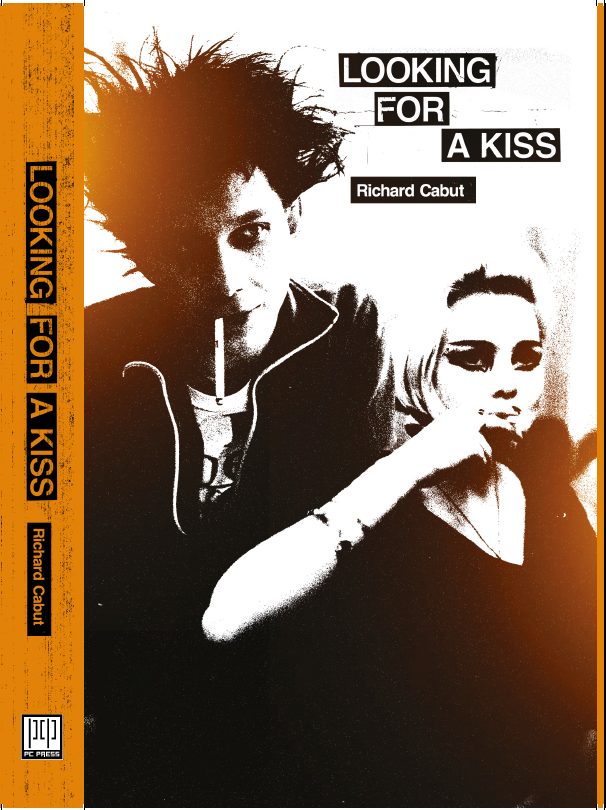
Looking for a Kiss is a pre-punk, post punk and punk novel – but not in a boring stupid way. It’s an 80s beat Freudian fairy tale – bad weather in the English soul.
Set in London and New York, the book is a fabulous chronicle of speed, madness and flying saucers (Warhol/Edie Sedgwick reference) – acid, pop art, teenage perversity (Patti Smith reference), the nature of melancholy, breakdown, breakup and breakout, the Spectacle, clairvoyance, personality crises, primal scenes, screams and schemes, the eternal quest for sprezzatura and the endless search for redemption. And much more.
I wrote it because I wanted a book that is like Patti Smith watching Television in 1974 – and writing about it; like the Velvet Underground live in a bombsite. There are no bands or anything so boring in Looking for a Kiss, but it does hang out on the backseats of buses and cinemas, poolhalls, waterfronts and anywhere it rains – youth youth youth! Looking for a Kiss smokes French cigarettes and also luxury length St Moritz menthol – just like Bryan Ferry. Looking for a Kiss is Richard Hell tuning up and shooting up. It is the tattoo on Judy Nylon’s back. It is also Judy Linn’s pictures of Patti Smith taken at the Chelsea Hotel, NYC, between 1969 and 1976. It is some cool people with bleached blonde hair collaborating and making plans to change the world. Looking for a Kiss is emotional truth – if you can handle it. Can you?
I guess these were the influences.
Looking for a Kiss has been adapted for the cinema, naturally. Keep an eye out. Looking for a Kiss is disorderly magic all the time (in the world).
Links
TalkPunk
Post comments, images & videos - Posts are checked and offensive or irrelevant ones will be removed