

50 Years Of Punk – Mark Sloper Screenbound Pictures **/5
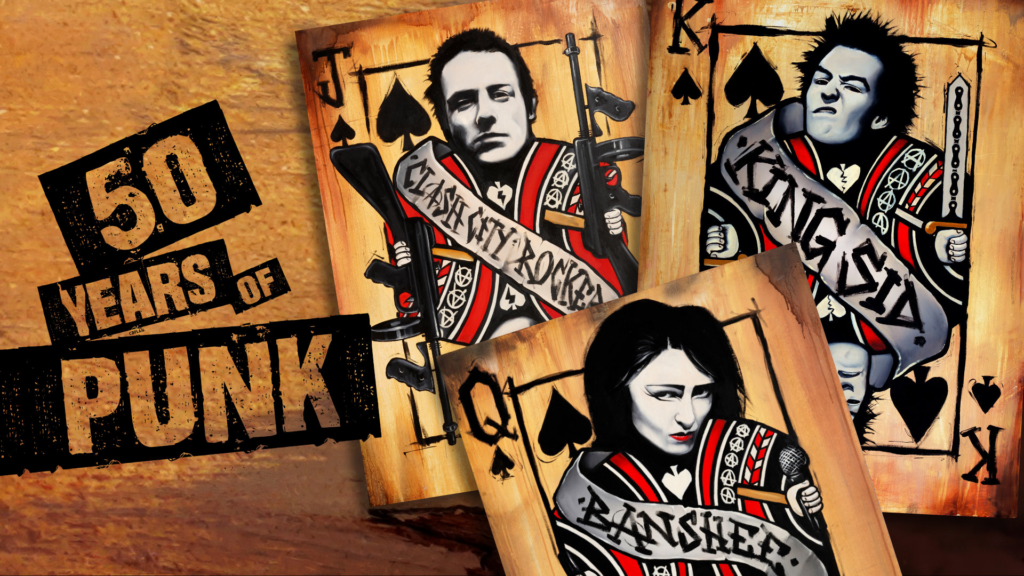
“To celebrate this momentous anniversary, this new documentary traces the explosion of punk on London’s King’s Road and is the most authentic insider account of punk’s evolution and legacy, by the artists and people who lived it. Fifty years on, punk’s core values of individuality, creativity, authenticity and freedom are more relevant than ever. Punk was never about the music – it is a way of life.”
I seem to be flying in the face of popular opinion here, but 50 Years of Punk doesn’t really work for me. The title alone sets an almost impossible task. How do you compress fifty years of punk into a single film? More importantly, what is the film actually trying to do, and who is it aimed at? Is it for those of us who were there (not necessarily 1976), in which case where are the new insights? Or is it aimed at kids discovering punk for the first time, in which case why not give them a clearer idea of how, where and why it all happened?
The other problem is the footage and sound. Good archive footage costs money, but it is absolutely crucial with punk because punk was as much visual as it was musical. There’s extensive use of the same piece of Clash footage, Punk In London and some Captain Trip recordings, seemingly from around 1978, which don’t necessarily match the events shown on screen. And, for me, any documentary about the birth of punk that doesn’t include the Sex Pistols’ legendary So It Goes performance is missing one of the defining visual documents of the entire movement. The Pistols in their confrontational glory, tearing through Anarchy in the UK — that’s punk. The audio used here appears to be live recordings of Sid singing, and it simply doesn’t have the same impact.
That combination of image and sound was one of punk’s great strengths. McLaren’s Sex Pistols understood that instinctively. It’s why there is so much extraordinary photography and film from the period: the bands looked incredible, but so did the audience. And that’s an important part of the story that this film largely misses. The fans weren’t just spectators — they were part of punk’s creative engine. You could be standing in the audience one night and be in a band the next, start a fanzine, put on a gig, form a record label or simply create your own version of what punk meant.
Which brings me to the interviews. Around 95% of the contributors were there at the beginning: Hugh Cornwell, Dave Vanian, Rat Scabies, Gaye Advert, Glen Matlock, Jah Wobble, Terry Chimes, Tony James and Viv Albertine, alongside footage of Vivienne Westwood and others. There are some pointless observations. Hugh, for instance, remembers how hot and sweaty gigs were in the heatwave of 1976 — but there were hardly any punk gigs taking place in 1976. He also makes the point that some bands had one great song and not much else. Fair enough, but so what?
Then comes the rather extraordinary observation from the co-director of The Great Rock ‘n’ Roll Swindle that if you see someone nowadays with an earring or brightly coloured hair, that was because of punk. Seriously? Never heard of Bowie?
The lack of ordinary fans is particularly noticeable. There are no real recollections from the people who bought the records, stood in the audience, started the fanzines, made the clothes, put on the gigs and created the scene around the bands. And contrary to the mythology, most of those people weren’t walking around in head-to-toe McLaren and Westwood either.
There is also a huge gap after the first wave. Richard Jobson and Charlie Harper are about the only representatives of the second wave. Dave Vanian and Charlie are among the few who can trace a continuous line from 1977 to the present. Most of the others moved on, reinvented themselves or, in some cases, spent years mocking the whole thing before returning when there was a book to promote, a reunion to stage, a record to reissue or one of those endless merry-go-rounds of mutual back-slapping podcasts to appear on.
The film ticks off some of the obvious subjects — McLaren’s shop, the Roxy Club, women in punk, the early punks — but often only in passing. Then, almost overnight, we’re landed in the present day and Rebellion Festival.
But how did punk survive when people like Jon Savage and others interviewed said it was dead by the end of 1977? And why did it mutate rather than disappear?
That’s surely one of the most interesting stories. Charlie Harper would have been an ideal person to interrogate about it. In 1977, information was incredibly difficult to find. If you wanted to hear about an obscure American punk band, discover what had happened to a 1960s garage group, or find out what was happening in another city, you had to hunt for records, magazines, fanzines and word-of-mouth information.
By 2000, everything had changed. The new glossy Q and Mojo magazines were digging up the past, CDs were reissuing everything, record companies were licensing old material, seminal books on punk such as England’s Dreaming had appeared, the Pistols had reformed, and American pop punk had exploded. Then came the internet, downloading, streaming and social media. Suddenly the entire history of punk was available at the click of a button.
And there was another factor: the punk generation got older. People who had discovered punk in 1976 and 1977 now had disposable income, could afford to travel to gigs and buy records, while many of the original bands were still capable of getting on stage. Punk didn’t die. It became part of people’s lives.
The documentary’s claim that “punk’s core values of individuality, creativity, authenticity and freedom are more relevant than ever” is where I start to disagree. I don’t think punk ever had a single set of core values. Individuality, creativity, authenticity and freedom could describe David Bowie or artists in jazz, hip-hop, metal or half the artists who have ever picked up a guitar.
If punk had one particularly important additional characteristic, I’d argue it was openness — and, at its best, an instinctive rejection of racism and the rigid social divisions of the time. Which makes some of the views expressed by certain former punks — and some of the things posted by certain promoters today — particularly uncomfortable when viewed against the politics of 1977.
And perhaps trying to define punk is the wrong approach anyway. The philosopher Wittgenstein used the word “game” to demonstrate that some things don’t share one single defining characteristic. Board games, card games and sports aren’t all alike, yet we recognise them as belonging to the same broad family through overlapping similarities.
Punk is much the same.
Rockabilly, 60s garage and psychedelia, the Small Faces, MC5, Velvet Underground, Bowie, Roxy Music, Can, the Sex Pistols, Throbbing Gristle, UK Subs, GBH, Green Day, Rancid, Gallows, Split Dogs etc etc — you can draw a line between some of them, but not all of them. And that’s the point. People found their own way into punk, then worked backwards, forwards and sideways through music.
Perhaps the most telling (and surprising) contribution comes from Jon Savage, who talks about when he first heard punk with such genuine passion that he gets closer to the reason it has survived than anyone trying to define its “core values”.
Because ultimately it’s quite simple. You’re young. You hear that sheer racket for the first time. The guitar, bass and drums kick in, the hairs stand up on your arms, and suddenly you want to be part of it.
That’s the drug.
It was there with rock’n’roll in 1956. It was there in 1976. It was there when punk mutated into post-punk, hardcore, pop punk, anarcho-punk and everything else. And it’ll still be there as long as somebody plugs in a guitar, switches on a synthesiser, makes music in an app or puts a record on a turntable.
So watch 50 Years of Punk when it arrives on Netflix and make up your own mind.
TalkPunk
Post comments, images & videos - Posts are checked and offensive or irrelevant ones will be removed


Good analysis..so many people who weren’t there jumping on the bandwagon
It was all a load of bollocks with no future..not proper ANARCHY IN THE YUK🧿🧷⚰️💉